
Advanced Energy Systems
Integrated Energy for Net-Zero Construction
Energy performance begins with the building itself.
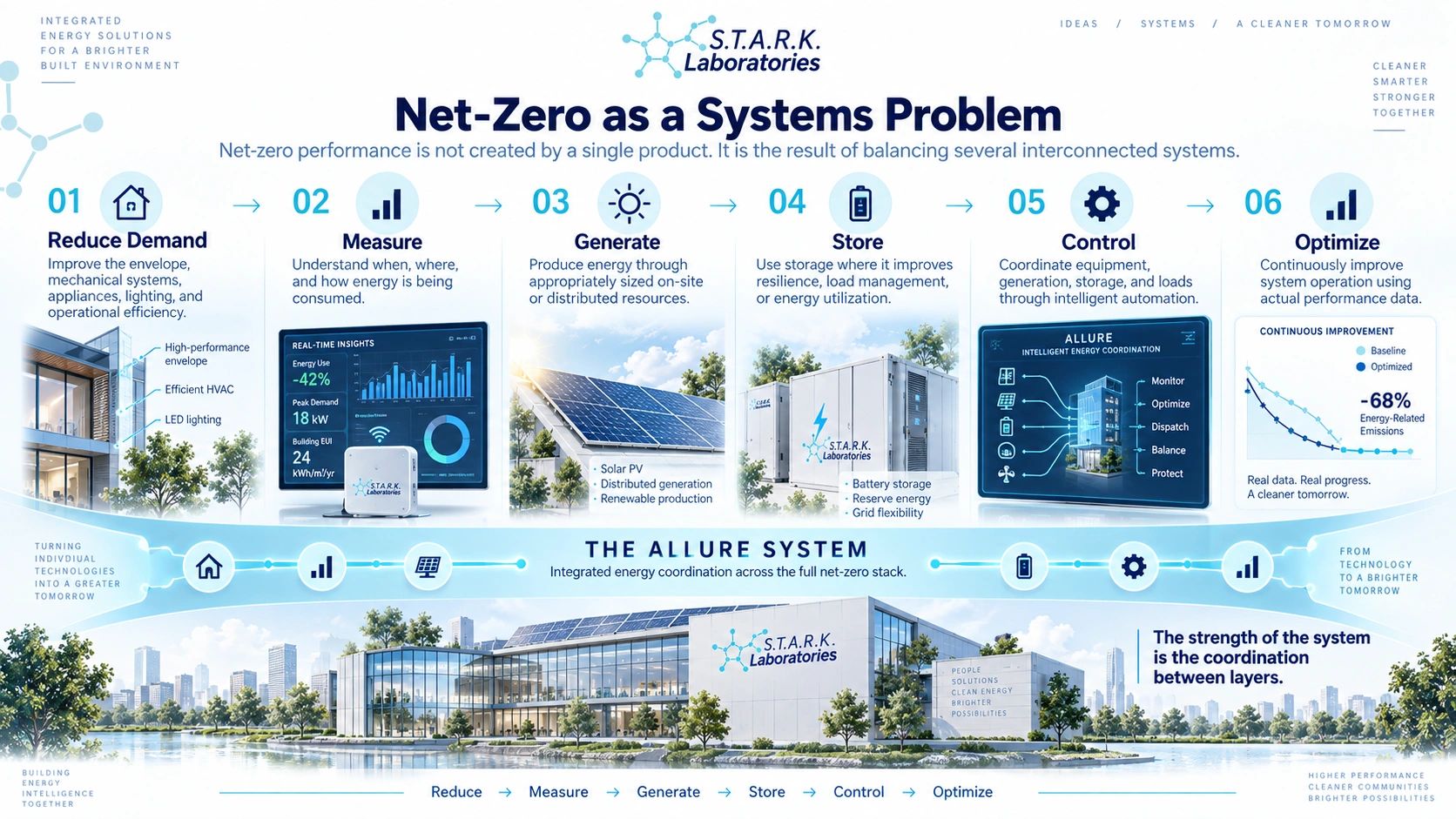
S.T.A.R.K. Laboratories approaches advanced energy as a complete system rather than a collection of disconnected products. Generation, storage, controls, building-envelope performance, mechanical loads, and real-time energy management all influence one another.
Why Work With Us
Experienced professionals dedicated to your success.
The objective is to reduce demand first, manage energy intelligently, and then supply the remaining load as efficiently as practical.
At the center of that strategy is the Allure System—an integrated energy platform designed to support high-performance and net-zero construction by coordinating the technologies that produce, condition, store, monitor, and manage energy throughout a building or development.
The broader philosophy is straightforward:
Reduce the load. Produce efficiently. Manage intelligently. Use energy where it matters.
The Allure System
Energy as an Integrated Building System
The Allure System is envisioned as the energy-management backbone of a high-performance building.
Rather than treating power generation, energy storage, HVAC, lighting, controls, and building performance as separate disciplines, the system is designed to coordinate them within a common operating architecture.
Its role is to help answer four questions continuously:
How much energy is available?
How much energy is being consumed?
Where is that energy being used?
How should the system respond?
That information can be used to improve how energy moves through the building and to reduce unnecessary consumption without compromising the intended use of the space.
Potential elements of an integrated Allure architecture can include:
- Distributed energy generation
- Solar photovoltaic systems
- Battery and energy-storage systems
- Inverters and power-conditioning equipment
- Maximum Power Point Tracking
- Smart electrical distribution
- Building-energy monitoring
- Automated load management
- HVAC coordination
- Lighting controls
- Sensors and environmental monitoring
- Backup-power integration
- Microgrid controls
- Demand-management logic
- Centralized supervisory controls
- Remote system visibility
The strength of the concept is not any one component.
It is the coordination between them.
Maximum Power Point Tracking
Variable energy sources do not produce the same output under every operating condition.
Solar irradiance, temperature, shading, electrical load, and system configuration can all affect the amount of usable power available from a photovoltaic system.
Maximum Power Point Tracking, or MPPT, continuously adjusts the electrical operating point of a compatible generation system so it can operate closer to its available maximum-power region as conditions change.
Within the Allure System, MPPT can become part of a larger energy-management strategy rather than functioning as an isolated inverter feature.
Generation data can be coordinated with:
- current building demand,
- battery state of charge,
- critical and noncritical loads,
- time-dependent energy priorities,
- backup generation,
- and grid interaction where applicable.
This allows the building to respond to the energy that is actually available instead of operating around a fixed assumption.
The objective is not simply maximum production.
It is maximum useful production.

Net-Zero Construction Efficiency Before Generation
A net-zero building should not begin with the question:
How many solar panels can we install?
It should begin with:
How little energy can this building reasonably require?
S.T.A.R.K.'s net-zero construction philosophy starts by reducing the building's underlying energy demand.
That means looking first at the physical structure:
- Building-envelope performance
- Insulation
- Air sealing
- Thermal bridging
- Window and door performance
- Solar heat gain
- Roof assemblies
- Moisture management
- Efficient lighting
- High-efficiency mechanical systems
- Intelligent controls
Every unit of energy that does not need to be consumed is energy that does not need to be generated, stored, conditioned, or purchased.
That changes the economics of the entire system.
The Building Envelope as an Energy Technology
The building envelope is one of the most important energy systems in any structure.
Walls, roofs, windows, doors, insulation, and air-sealing systems determine how aggressively the mechanical system must work to maintain indoor conditions.
S.T.A.R.K.'s work in advanced materials and building systems supports this energy strategy.
High-performance construction can reduce thermal losses and uncontrolled air movement, allowing heating and cooling equipment to operate under a smaller and more predictable load.
This creates a cascading benefit:
Better envelope → lower HVAC demand → smaller equipment requirements → lower energy consumption → smaller generation requirement → smaller storage requirement.
The cheapest unit of energy is often the one the building never needed in the first place.
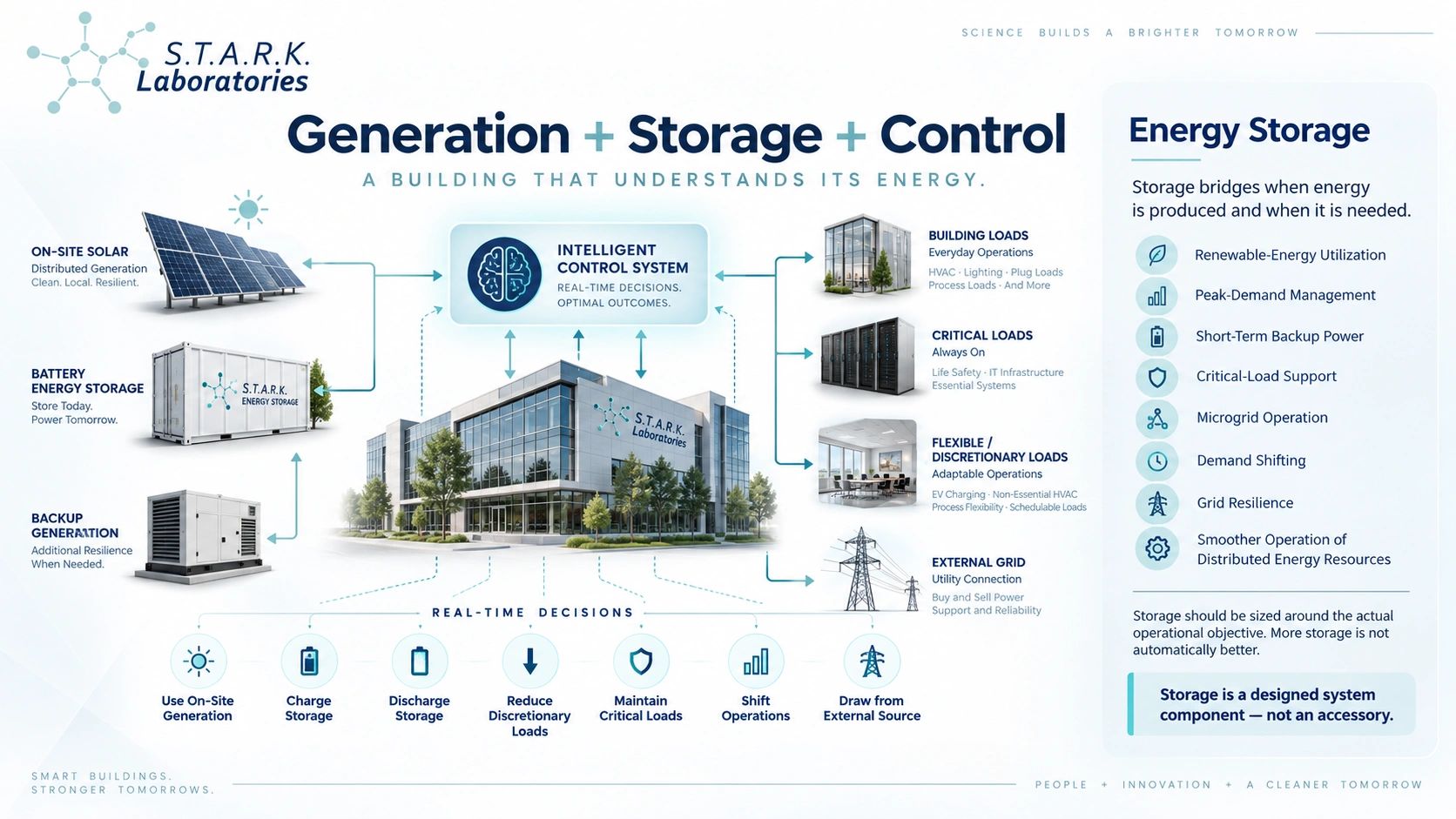
Generation + Storage + Control
A Building That Understands Its Energy
Energy generation is valuable.
Energy storage is valuable.
But without intelligent control, both can be underutilized.
A smarter building can make operating decisions based on conditions in real time.
For example, the system can determine when it is appropriate to:
- use available on-site generation,
- charge energy storage,
- discharge stored energy,
- reduce discretionary loads,
- maintain critical loads,
- shift certain operations,
- or draw from an external source.
The building becomes an active participant in its own energy management.
That is a fundamental shift from conventional construction.
Energy Storage
Storage can provide an important bridge between when energy is produced and when it is required.
An integrated storage system can potentially support:
- Renewable-energy utilization
- Peak-demand management
- Short-term backup power
- Critical-load support
- Microgrid operation
- Demand shifting
- Grid resilience
- Smoother operation of distributed energy resources
Storage should be sized around the actual operational objective.
More storage is not automatically better.
The correct system depends on the building load profile, generation profile, desired resilience, available capital, regulatory environment, and expected operating conditions.
S.T.A.R.K.'s approach is therefore to treat storage as a designed system component, not an accessory.
Intelligent Load Management
Not every load is equally important.
Hospitals, data facilities, industrial sites, residences, and commercial buildings all contain equipment with different operational priorities.
An intelligent energy architecture can classify loads according to need.
Critical Loads
Systems that must remain operational whenever technically possible.
Priority Loads
Important loads that may be managed but should generally remain available.
Flexible Loads
Equipment that can potentially be shifted, reduced, or temporarily interrupted.
By understanding those priorities, the system can make more intelligent decisions during periods of limited generation, high demand, utility interruption, or constrained storage.
That is particularly important in resilient and off-grid-capable systems.
Advanced Controls & Monitoring
Measure What Matters
Real energy optimization requires good data.
The Allure System can incorporate monitoring at multiple levels:
- Whole-building energy use
- Individual electrical circuits
- Generation output
- Battery state of charge
- Inverter performance
- HVAC consumption
- Water-heating demand
- Lighting loads
- Equipment operating status
- Environmental conditions
- Temperature and humidity
- Fault and alarm conditions
A central dashboard can give facility operators a clear picture of current performance while preserving historical data for analysis.
Patterns that were once invisible become measurable.
And what can be measured can be improved.
From Home to Community
The same principles can extend beyond a single building.
A collection of high-performance buildings can become part of a larger coordinated energy system.
At a community scale, intelligent infrastructure may eventually allow:
- Shared generation
- Distributed energy resources
- Community storage
- Microgrids
- Coordinated demand management
- Water and energy system integration
- Commercial and residential load balancing
- Resilient critical infrastructure
That is where net-zero construction becomes more than a building strategy.
It becomes a community infrastructure strategy.

NET-POSITIVE
Beyond Net-Zero
Net-zero is an important benchmark, but the larger objective is resilience.
A building can achieve strong annual energy performance and still remain vulnerable to outages, poor controls, inefficient peaks, or inadequate system coordination.
S.T.A.R.K.'s longer-term energy philosophy therefore goes beyond simply balancing annual consumption and production.
The objective is to create buildings and infrastructure that are:
Efficient
Reduce unnecessary energy consumption.
Intelligent
Understand operating conditions and respond automatically.
Resilient
Maintain important functions during changing or disrupted conditions.
Flexible
Integrate multiple generation, storage, and control technologies.
Scalable
Operate at the level of a home, commercial building, industrial facility, or community.
ENERGY SHOULD NOT BE AN AFTERTHOUGHT
For decades, buildings have largely been designed first and supplied with energy second.
S.T.A.R.K. Laboratories is working toward a different model.
A model where materials, construction, generation, storage, controls, and energy demand are considered together from the beginning.
Because the future of advanced energy is not simply about producing more electricity.
It is about building systems that require less, understand more, and use what they have intelligently.
