STARK Laboratories

STARK LaboratoriesSTARK LaboratoriesSTARK Laboratories
  • Sign In
  • Create Account

  • My Account
  • Signed in as:

  • filler@godaddy.com


  • My Account
  • Sign out

  • Home
  • Explore Our Technology
  • Partner With S.T.A.R.K.
  • More
    • Home
    • Explore Our Technology
    • Partner With S.T.A.R.K.

STARK Laboratories

STARK LaboratoriesSTARK LaboratoriesSTARK Laboratories

Signed in as:

filler@godaddy.com

  • Home
  • Explore Our Technology
  • Partner With S.T.A.R.K.

Account


  • My Account
  • Sign out


  • Sign In
  • My Account

Environmental & Water Systems

Resilient Water. Smarter Resource Use. Healthier Communities.

Water is not a secondary utility. It is one of the systems every community depends on every day.

Green R.O.O.M. and Water W.O.R.K.S. are intended to support a broader environmental infrastructure strategy built around water treatment, reuse, controlled-environment agriculture, resource efficiency, and more resilient local systems.


The objective is to move beyond the traditional model of treating water, energy, food, and the built environment as separate systems.


Instead, the long-term vision is to connect them.


Treat water intelligently. Reuse what can be reused. Produce more locally. Reduce waste. Strengthen resilience.

Partner Intranet

Validation and Documentation available to qualified partners under NDA. 

Green ROOM

Green R.O.O.M.

Controlled-Environment Agriculture & Resource Integration

Green R.O.O.M. is being developed as a platform for controlled-environment growing systems and localized food production.

The concept is built around one practical idea:


Food production should become more predictable, more efficient, and less dependent on distance.

Traditional agriculture is influenced by weather, geography, transportation, water availability, and seasonal conditions.

Controlled-environment systems create the opportunity to manage more of those variables directly.

Potential applications can include:

  • Hydroponic growing systems
  • Controlled-environment agriculture
  • Indoor crop production
  • Water-efficient growing methods
  • Nutrient-management systems
  • Environmental monitoring
  • Automated irrigation
  • Lighting controls
  • Temperature and humidity management
  • Local food production for residential and commercial communities

The goal is not to replace conventional agriculture.

It is to create another layer of food resilience where local conditions, land constraints, or infrastructure needs make controlled production valuable.


Water as a Productive Resource

In a conventional system, water may be used once and discharged.

In a more integrated system, water can potentially be monitored, treated, recirculated, and reused where appropriate.

Green R.O.O.M. systems are intended to take advantage of that principle.

Water use can be coordinated with:

  • irrigation demand,
  • nutrient delivery,
  • plant requirements,
  • environmental conditions,
  • treatment capacity,
  • and available energy.

That turns water from a simple input into a managed resource.

The more precisely the system understands demand, the less water needs to be wasted.

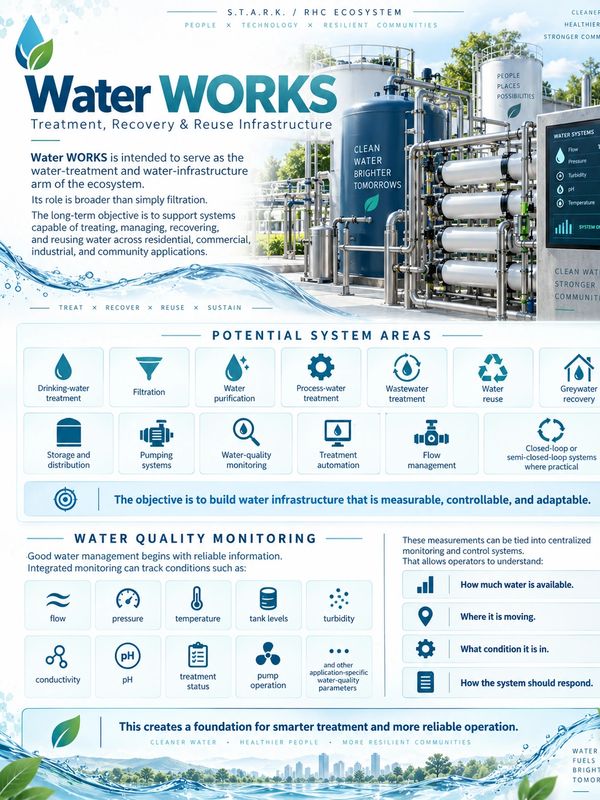
Water WORKS
Water WORKS

Treatment, Recovery & Reuse Infrastructure

Water WORKS is intended to serve as the water-treatment and water-infrastructure arm of the ecosystem.

Its role is broader than simply filtration.

The long-term objective is to support systems capable of treating, managing, recovering, and reusing water across residential, commercial, industrial, and community applications.

Potential system areas include:

  • Drinking-water treatment
  • Filtration
  • Water purification
  • Process-water treatment
  • Wastewater treatment
  • Water reuse
  • Greywater recovery
  • Storage and distribution
  • Pumping systems
  • Water-quality monitoring
  • Treatment automation
  • Flow management
  • Closed-loop or semi-closed-loop systems where practical

The objective is to build water infrastructure that is measurable, controllable, and adaptable.


Water Quality Monitoring

Good water management begins with reliable information.

Integrated monitoring can track conditions such as:

  • flow,
  • pressure,
  • temperature,
  • tank levels,
  • turbidity,
  • conductivity,
  • pH,
  • treatment status,
  • pump operation,
  • and other application-specific water-quality parameters.

These measurements can be tied into centralized monitoring and control systems.

That allows operators to understand:

How much water is available.
Where it is moving.
What condition it is in.
How the system should respond.

This creates a foundation for smarter treatment and more reliable operation.


Treatment + Monitoring + Control

Water Systems That Can Respond

A modern water system should do more than move water from Point A to Point B.

It should be able to understand changing conditions and respond accordingly.

An integrated Water WORKS architecture may include:

  • sensors,
  • pumps,
  • valves,
  • treatment equipment,
  • storage,
  • automation,
  • supervisory controls,
  • alarms,
  • and data logging.

Control logic can help coordinate equipment based on actual demand.

For example, the system may respond to:

  • tank level changes,
  • pressure changes,
  • treatment capacity,
  • changing water demand,
  • maintenance conditions,
  • abnormal sensor readings,
  • or equipment faults.

This improves visibility while reducing unnecessary manual intervention.


Water Reuse & Recovery

Use Water More Than Once Where It Makes Sense

One of the largest opportunities in environmental infrastructure is to reduce unnecessary demand for newly supplied water.

Water reuse can help by recovering water from appropriate sources, treating it to the required standard, and redirecting it to suitable applications.

Potential reuse applications may include:

  • landscape irrigation,
  • agricultural systems,
  • non-potable building uses,
  • industrial processes,
  • cooling applications,
  • or other approved uses appropriate to the treatment level.

The principle is simple:

Not every use requires the same quality of water.

By matching water quality to the actual use, communities may be able to reduce total consumption while preserving higher-quality water for applications that truly require it.

Environmental & Water Systems


Green R.O.O.M. + Water WORKS

Closing the Loop

The strongest opportunity comes when Green R.O.O.M. and Water WORKS operate together rather than independently.

Water WORKS can provide treatment, recovery, storage, monitoring, and distribution.

Green R.O.O.M. can create productive demand for appropriately treated water through controlled-environment agriculture.

Together, the systems can support a more circular model:

SOURCE → TREAT → USE → RECOVER → REUSE → PRODUCE

This creates the potential to reduce waste while increasing local productivity.


Environmental Infrastructure as a System

Water does not exist in isolation.

It interacts with energy, buildings, food production, land use, and community infrastructure.

A water-treatment system may be coordinated with energy availability.

Agricultural systems may be coordinated with water-reuse capacity.

Buildings may be designed around lower water demand.

Monitoring systems may provide data across multiple infrastructure functions.

The result is a broader environmental platform rather than a single piece of equipment.


Residential Communities

Water treatment, reuse, irrigation management, and community-scale food production.


Commercial Developments

Water monitoring, conservation, reuse, landscape management, and controlled growing environments.


Industrial Facilities

Process-water management, treatment, recovery, monitoring, and reuse.


Master-Planned Communities

Integrated water infrastructure coordinated with housing, utilities, commercial areas, and agriculture.


Remote or Resilient Sites

Systems designed around reduced dependence on centralized infrastructure where appropriate.


Haven by the Lake

A Potential Full-Scale Environmental Infrastructure Platform

Haven by the Lake provides a natural setting for the broader Green R.O.O.M. and Water WORKS strategy.

Rather than treating water and food systems as later-stage amenities, they can be considered as part of the infrastructure plan from the beginning.

That can include:

  • water sourcing,
  • treatment,
  • storage,
  • reuse,
  • irrigation,
  • controlled agriculture,
  • monitoring,
  • utility coordination,
  • and long-term resource planning.

The strategic opportunity is to create a community where water, energy, food, housing, and industry are considered as interconnected systems.

That is fundamentally different from developing each one independently and trying to connect them later.


Integrated Controls & Environmental Intelligence

Green R.O.O.M. and Water WORKS also fit directly into the broader S.T.A.R.K. intelligent-infrastructure model.

Sensors and controls can help monitor:

  • water usage,
  • treatment performance,
  • pump operation,
  • environmental conditions,
  • irrigation demand,
  • crop conditions,
  • energy consumption,
  • and system alarms.

That information can then be coordinated with automated controls.

The result is infrastructure that can be managed based on actual conditions rather than fixed assumptions.


Efficiency Through Integration

The goal is not simply to reduce water use.

It is to create a more efficient relationship between:

Water
Energy
Food
Buildings
Infrastructure

For example:

A controlled growing system may need water and energy.

A treatment system may consume energy.

A building may generate recoverable water.

A power system may have periods of excess generation.

An integrated platform can begin coordinating those relationships.

That is where environmental infrastructure becomes intelligent infrastructure.


Development Path

Like the other technology platforms within the RHC ecosystem, Green R.O.O.M. and Water WORKS should move through a disciplined path:

01 — Define

Determine the water, food, environmental, and infrastructure problem being solved.

02 — Engineer

Develop treatment systems, growing systems, controls, monitoring, and integration requirements.

03 — Validate

Test performance, water quality, system efficiency, reliability, and operating assumptions.

04 — Certify

Address applicable health, safety, environmental, plumbing, agricultural, and regulatory requirements.

05 — Deploy

Integrate qualified systems into real residential, commercial, industrial, or community applications.


The Larger Environmental Vision

The future of environmental infrastructure is not simply about treating more water.

It is about using resources more intelligently.

It means understanding how much water is available.

How much is needed.

Where it goes.

What can be recovered.

What can be reused.

And how water can support other productive systems such as agriculture.

Green R.O.O.M. and Water WORKS are intended to help build that capability within the RHC ecosystem.

WATER → TREATMENT → REUSE → FOOD → COMMUNITY


The long-term goal is straightforward:

Cleaner resources. Smarter systems. Stronger communities.

Green R.O.O.M. + Water WORKS

Treat intelligently. Grow locally. Waste less. Build resilience.

Find out more

Copyright © 2026 STARK Laboratories - All Rights Reserved.

This website uses cookies.

We use cookies to analyze website traffic and optimize your website experience. By accepting our use of cookies, your data will be aggregated with all other user data.

Accept